Your Professional Trekking Services
A Bantu people whose ancestors gave Mt Elgon its truest name. For centuries they have farmed its volcanic slopes, guarded its forests, and upheld the Imbalu — one of Africa's most celebrated rites of passage.
The Bamasaaba — also known as the Bagisu — are a Bantu people who have inhabited the western and southern slopes of Mt Elgon for centuries. Their very name is inseparable from the mountain: Masaba, the name they give both their legendary ancestor and the mountain itself, is older than any European map of the region.
According to oral tradition, their founding ancestor Mundu settled in the upper reaches of the mountain above the caldera, living by hunting and harvesting bamboo shoots. His son Masaba became a leader whose three sons — Mwambu, Mubuuya, and Wanale — founded the three primary clan groups still present in Sironko, Bududa, and around Mbale city today.
Today the Bamasaaba number in the millions across Eastern Uganda, with the Inzu Ya Masaba — established in 2010 — serving as the formal cultural institution for the community, rotating leadership among the three primary clans every five years.
Held every even-numbered year between August and December, the Imbalu is one of Africa's most celebrated and dramatic rites of passage. It defines what it means to be a Bamasaaba man.
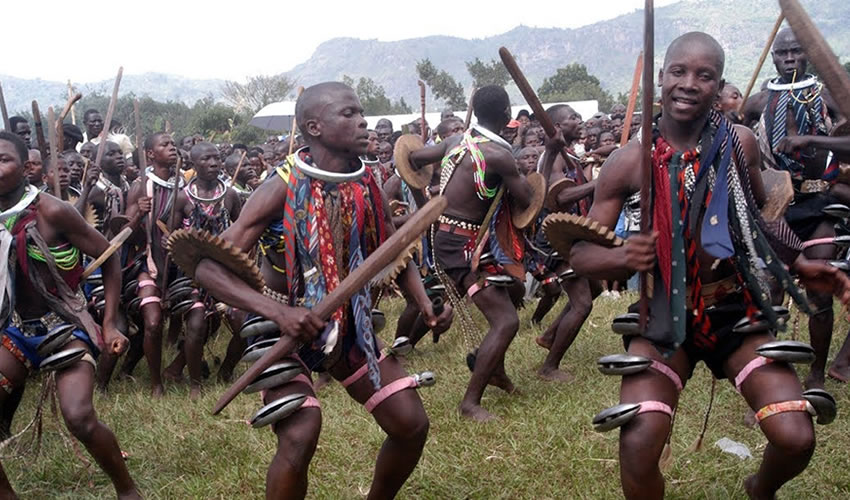
Beyond the Imbalu, the Bamasaaba have a rich and layered cultural life shaped by the mountain's agricultural abundance and deep spiritual heritage.
The Bamasaaba are skilled farmers of Mt Elgon's fertile volcanic slopes. Arabica coffee is central to their economy. A unique delicacy is Malewa — bamboo shoots harvested seasonally (May to August) from the mountain forest, dried, smoked, and cooked as a sauce with groundnuts. They also grow bananas, cassava, maize, sorghum, beans, and yams.
Pre-Christian Bamasaaba beliefs centred on Wele, a supreme God supported by subsidiary deities: Wele Maina (animal fertility), Wele Nabende (crop productivity), and Wele Nabulondele (guardian of childbirth). Anglicanism arrived in the 1890s — today Christianity and traditional beliefs coexist in most communities.
The Bamasaaba speak Lugisu (also called Lumasaaba), a Bantu language with regional dialects: Lubuuya in the south, Ludadiri in the north, and Lubukusu among related communities in western Kenya. Lumasaaba is mutually intelligible with the Bukusu language of Kenya. Most Bamasaaba also speak English and Swahili.
Marriage is arranged between families and involves a bride price negotiated in livestock — traditionally three to ten cows, supplemented by goats, spears, and hoes. Bamasaaba society is strongly patrilineal; the clan (sikoka) governs inheritance and social duty. Circumcision is a prerequisite for marriage for men.
Bamasaaba society is organised into 26 named clans, including Wanaale, Mwambu, and Mubuuya — each named for founding ancestors of the three primary lineages. Today, the Inzu Ya Masaba — established in 2010 — provides formal cultural representation with five-year rotating leadership among the three primary clans.
The Kadodi — the dance and song that accompanies the Imbalu ceremony — is perhaps the most well-known, but music marks births, deaths, harvests, and community gatherings across all seasons. Traditional instruments include drums, flutes, and lyres. The Imbalu season transforms the entire region into a living festival every even-numbered year.
Mt Elgon is our only source of water. It is also the source of who we are. Every forest, every river, every cave carries the memory of our ancestors. When we guide people up this mountain, we are sharing a home, not just a view.
— A Bamasaaba Elder, Budadiri
Every trek with Elgon Trekking Services passes through the living landscape of Bamasaaba culture. Here is what you can expect on the trail and in the communities below.
The lower Sasa Trail passes through the smallholdings of Bamasaaba farming families — coffee gardens, onion plots, potato fields, and banana groves all tended by generations of mountain people. This is daily life, and you pass through it as a respectful guest.
Our guides are Bamasaaba men from the communities around Budadiri. They share the oral histories of the mountain — the story of Masaba, the origin of Imbalu, the history of the caves and peaks — as their own story, told at their own pace around the camp fire or in the forest.
If your visit falls in an even-numbered year between August and December, you may encounter Imbalu celebrations on the lower slopes — the sound of Kadodi drums, initiates dancing through the villages smeared with malwa yeast, the energy of a community in full ceremony.
When in season (May to August), our camps may serve Malewa — the dried bamboo shoots harvested from the mountain forest central to Bamasaaba cuisine. Cooked as a sauce with groundnuts and served with matoke or posho, it is the taste of the mountain itself.
The mountain produces some of Uganda's finest specialty arabica coffee. We source our camp coffee locally, and on the lower trail you pass through the very gardens where it is grown. Many of our team come from coffee-farming families and are happy to talk about the crop.
Our guides know the history behind every name on the mountain — why Masaba Peak was renamed Jackson's Summit by colonial explorers, where Mwambu Falls gets its name, what Nabunyifu means in Lumasaaba. Walking with a guide who knows this landscape by its real names transforms a trek into something deeper.
Book a trek with Elgon Trekking Services and walk through one of East Africa's most culturally rich landscapes, guided by the Bamasaaba people who have called it home for centuries.